
English
A New Beginning
Time slips past in a flash — it has been nearly a year since I last picked up the pen to write a summary. Today I have calmed down to sort through the past, wanting to put into words the path I have walked and the feelings I have carried from the college entrance exam to now, to leave a mark on these three and a half years of youth — so that this stretch of the road does not feel like it was walked for nothing. Looking back, this road is paved with regrets, hides countless graceless moments, and has quietly accumulated growth.
Smooth Schooling, a Messy Self
Before the high school entrance exam, life went fairly smoothly. I moved forward step by step along the goals my father had set. Coursework in primary and middle school was not heavy, and I was willing to put my mind into studying. I once took first place in my grade, stayed firmly near the top, and got into my target high school without any suspense.
But outside of academics I lived in a complete mess. Especially in love and in relationships with people, I was selfish and cowardly. All the later tug-of-war and disappointments, looking back now, were causes I planted myself.
I have always been someone unwilling to show weakness. To keep up appearances I told quite a few lies, and was often pushed by vanity to tough it out — even today I still slip now and then. I know lying is wrong, and I always want to be an open and honest person, but the stubbornness and pride of youth ended up hurting quite a few people I never wanted to hurt.
Behind a Thin Veil
The first person I think of is my good brother. In the third year of middle school, holding on to some inexplicable stubbornness about "wanting to change," I let a rift grow between us. At the final exam before the pandemic broke out, I estimated my score would be lower than his, and actually squatted in the middle of a ping-pong table in the winter rain and wailed — that was the only time in my whole life I lost my composure like that.
When the high school entrance results were posted, I had exceeded the unified admission line by nearly thirty points, ranking quite a bit higher than him. At that moment I felt a secret delight, but what followed was a lingering sense of loss. Over the summer vacation I made a point of going to his home to find him, wanting to untie that knot with my own hands. Later, on the strength of a quota for targeted students, he got into the same high school as me. Before we chose our tracks we were in neighboring classes; after we chose, we unexpectedly ended up in the same class.
The coincidences of fate always make one sigh. I had long let go of that old rivalry, yet I never had the courage to have an honest talk with him about the past. Between us, in the end, it was as if a thin veil hung in between — we could never go back to being completely unguarded.
A Crush That Faded Without a Trace
And then there was her. I could never bring myself to apologize because of so-called face, and even now I occasionally dream of her. I cannot quite explain why myself; perhaps the flutter had already begun the first time I saw her in September 2017.
In adults' eyes, middle school romance is just playing house, but when it lands on you, every emotion burns hot and real. The happiest days were all in the first half of the story: chatting with her slowly, closing the distance bit by bit. Academics were going well then too — I placed first among more than a thousand students in my grade, and I could not help getting a little full of myself. Ordinary-looking as I was, having been confessed to by a girl in primary school gave me some blind confidence, so at the sports meet I confessed to her, and just like that we were together.
But the relationship lasted only a little over two months. I failed to hold on to first place in the grade at the final exam, and my father went through my QQ chat history and found out about us. At his urging, I used "studying should come first" as an excuse and broke up with her over QQ. The awkwardness of having my privacy laid bare in front of my parents, together with the muddled judgment of youth, made me accept those "self-evident" constraints all too easily.
After the breakup she had a poor impression of me. I went shamelessly to her to get back together, and surprisingly she agreed. But not long after, because of problems of my own, she broke up with me again. That day she came to me all hesitant, the words dying on her lips; I could guess what she wanted to say, so I went along with it and we split up. Only later did I learn that she soon had a new relationship, while I was still kept in the dark, even lowering myself again and again to beg for a reconciliation. Even more dramatic, she later ended up with that good brother of mine.
In those days I was like someone who could not stand the light, repeatedly prying into her Moments feed. It was not until university that I heard news of her again: she was already sitting in someone else's passenger seat, and had got into Northeastern University, while I was only at a school that is neither 985 nor 211. The moment that sense of disparity washed over me, I truly realized that some people and some things had long since stopped in the past.
Walking Inward
The three years of high school were on the whole steady, but they also made it hard for me to fall for anyone again — along the way I did meet girls who gave me illusions, but looking back they were all insignificant. More importantly, in high school I began to learn to look inward, to see bit by bit what I was really like, and to try to face my own flaws head-on.
I have to admit that my natural gifts are very limited. Compared with the outstanding classmates around me, my comprehension was a good deal slower, and I never threw myself wholly into studying. Life was loose — playing ball, reading books, and by senior year even lying in bed every night watching comics and anime on my phone. So that score on the college entrance exam was in fact foretold long before; there is nothing to feel wronged about.
But the teachers and classmates of Kangjie Middle School remain the warmest underpainting of my youth whenever I think back. Special thanks to Teacher Li Jiang!
Choosing a Major and a Misunderstanding
After the exam scores came out, filling in the college preferences became a problem. I did not dare hope for a 211, and Taiyuan University of Technology was actually a safe bet, but I wanted to leave the province and see the world outside. As someone from Yuncheng, the farthest place I had ever been before that was Xi'an.
By a stroke of luck, I was admitted to the Information and Computing Science program in the School of Mathematics and Computing Science at Guilin University of Electronic Technology. The moment I saw the admission result, I was stunned — because of my own carelessness, I had thought it was a computer science program; only after enrolling did I learn it was an interdisciplinary mix of mathematics and computing. Fortunately it was not bad overall, so I settled down.
Starting from Zero
The very day I first stepped through the university gate I knew clearly that the gap in academic credentials had already opened, and that if I slacked off further I would only be left further behind. So over these three-plus years I have kept pushing forward, grabbing opportunities, and wanting to make up for the regrets left behind in my youth.
It happened to coincide with the end of the pandemic, and I saw the largest military training in the history of GUET — at least three cohorts training together. At first it was ordinary training; then one day a classmate from the university's armed forces department came round recruiting people, saying that over on their side they specialized in tactical drills, which would be more tiring and harder going. I went without a second thought. Later I was assigned to the medical squad and made a few friends. Looking back, none of the people who trained in combat drills with me were ordinary: one was the grade leader of the School of Mechanical and Electrical Engineering, who got recommended for graduate study at Shandong University; another was the chair of the university's ACM base, who had just won a bronze medal at the Chengdu contest not long before.
For a while I was thoroughly fooled by the guy in the medical squad — whatever he bragged about, I believed, being a newcomer. But he did genuinely give me anxiety, forcing me to think seriously about which computing direction to choose. With limited vision, I did not dare dream of a university-level lab, so I could only choose among labs and clubs in my own school, and in the end I picked the Innovation Base.
Getting into the base required an assessment. As someone who had never studied computing, I could only chew through C on my own. A reminder here: do not watch Brother Peng's course, it is a pure waste of time — after a pile of it you will not remember a thing. Later I bought a copy of C Primer Plus, and over the five days of National Day I chewed through everything up to pointers and structs. Around the same time I was also on the school track team preparing for the university sports meet, so the days were actually quite full. The assessment passed easily. It was also then that I settled on going into cybersecurity, but the seniors in the base could not explain how to learn that direction either, so I could only first shore up the fundamentals of computing.
The first assessment after joining the base was to get a personal blog up. Back then I was fiddling with hexo. That is where I had my first encounter with frontend.
After the New Year, in order to learn cybersecurity properly, I started filling in Linux, computer networks and data structures. It was also then that I happened to see that the industrial control security lab was recruiting. The conditions said at least eight hundred yuan a month, and I heard everyone in there was from cybersecurity, information security or cryptography, and I was tempted. For the assessment everyone had to start from scratch and self-study for half a month on a designated platform; I studied for half a month too, and in the end made it into the offline round without incident. The offline round had hands-on range problems; I was a blank sheet, but luckily the range environment developed a fault and nobody could solve them. By sheer dumb luck I took sixth place on the multiple-choice and short-answer questions, passed the group interview too, and just like that got into the industrial control security lab. It recruited almost entirely sophomores who already had a foundation; our cohort only had three freshmen.
I chose reverse engineering. That path came with its own pain. The lab's atmosphere was strange — nobody knew what anyone else was doing, everyone kept their cards close to their chest. I went to ask a sophomore senior in reverse engineering how to learn it, and he was evasive. A fourth-year senior, though, said that I absolutely must write more blogs, and that if I wanted to practice reverse engineering I should try hand-rolling an operating system. Thinking about it now, that was the best advice I heard in those years.
But in the end I did not stick with it. I switched to studying Teacher Wang Shuang's Assembly Language, and that same summer I got ollama running on my own computer. I opened up a model, could ask and answer, and I found it quite novel. As for whose rice bowl this thing would eventually touch, I did not think about that at all. Around the same time I also tinkered with building PCs and multi-booting systems, and especially loved messing about with Arch Linux. Those days were truly happy.
It was also from then that I started going to the gym. In this respect I have a bit more talent than most people. Of course, that also laid the groundwork for later health problems.
The Price of Changing Course
In the first semester of sophomore year, I had my father get me a desktop. During that stretch I was obsessed with burning through headphones, while reverse engineering got blurrier and blurrier. My advisor was busy with work, and the four of us in the reverse engineering group were too embarrassed to disturb him. The one time we did manage to disturb him, he simply tossed over a wifi firmware and told us to reverse-engineer it and find vulnerabilities. I had not even got the hang of IDA Pro yet, and I froze on the spot. Later Fengtai's HR came to talk, and both Li Shuo and Qin Jiajia quit at this time. I figured there was still eight hundred yuan a month, so I kept drifting along. Along the way I briefly tried pentesting, but in security I ultimately made no real progress.
That semester I trained strength with others and got some small results. Most of my energy went into extracurriculars, and the price was failing Mathematical Analysis 3 and Probability Theory and Mathematical Statistics. I knew very clearly that I could not go on like this and had to find a way to break the deadlock.
Over winter break I had a conversation with a relative (bg double-nine, Huawei). After that conversation, something in me quietly set the goal of learning software development. It is just that at that time DeepSeek R1 had not come out yet, AI could only write a few functions, and I did not think it could replace programmers. Looking back now, that judgment was wildly wrong. Since I already leaned toward frontend, I chose frontend development.
In the second semester of sophomore year, racing against the Innovation Base's change of leadership, I frantically hand-rolled a management system — Vue 3, pure frontend with mocked fake data. On the strength of that alone I became deputy head of the software department. The rest of the time I spent working out how to actually use cloud servers; I learned a lot of ops stuff, practiced a great deal by hand, and learned a lot from Qin Jiajia.
And so it went on into the middle of the semester. The industrial control security lab was recruiting, Fengtai's HR came again, and the job fair had set up a booth too. This time I told her I was doing frontend, and it happened that Fengtai was hiring frontend, so she connected me with the power business unit to help maintain a cyber range project. That is also how I came to know Wang Liheng and Deng Zhibo. Deng Zhibo especially held nothing back, and has kept chatting with me on and off until now — a year and a half. He taught me so much, and I have never known how to thank him.
But at the same time I hit wall after wall. I was played on a college innovation project, and the summer in-person internship that Fengtai's HR had promised verbally also fell through. There was really nothing I could do about either of those, and I could only rage impotently. Along the way I also failed university physics and numerical analysis.
Physically things were even worse. Back then I had a cold and a cough, had almost stopped training, and was eating a lot, so my weight climbed all the way past a hundred kilograms. Just before summer break, my L5-S1 disc herniated, and it was extremely uncomfortable. After finishing teaching the freshmen in the summer term, I went home.
Retaking Courses and My First Interview
Having been worn down both physically and mentally, I went back to school after the summer and started studying backend specifically. That year's coursework was pressing too — four failed courses all had to be retaken, or even graduating would be in doubt. I could only squeeze out time to learn development, and this time I really did have to chew through full stack. I also took over the student progress management system and hand-rolled the project's outline by myself.
At the same time the Innovation Base began recruiting, and I organized the training. Some unpleasant things happened during this period. Wang Bofeng — this is a person I probably will not forget. I tried to help out of kindness and got bitten in return. There was really nothing I could do. Going forward I do not plan to have that kind of enthusiasm for newcomers again.
I also had my first proper internship interview, and it went terribly — I simply could not answer the basic things. After that, most of my time went into reviewing for exams. Fortunately Mathematical Analysis 3, Probability Theory and Mathematical Statistics, and university physics all passed, numerical analysis dragged into the second semester of junior year and passed there too, all four retakes were cleared, and the regular courses all passed as well. It is just that I had not trained for so long, had put the weight back on, and with salty, oily food and endless drinks, my body had already been pushed to the edge.
The Body Gave Out First
On December 18, 2025, I had been dizzy and had a headache for several days, and I woke at a little past five in the morning and could not get back to sleep. Thinking of my grandmother's pre-stroke symptoms, I went straight to Guilin People's Hospital — first to neurology, then transferred to cardiology. When they took my blood pressure, systolic was 160, diastolic 100, heart rate 120. The ECG came back as sinus tachycardia with T-wave changes. Head CT, cardiac ultrasound, adrenal ultrasound and bilateral kidney ultrasound all showed no abnormalities. After a few vials of blood: liver and kidney function damage, high glycated hemoglobin, high homocysteine. Measured again, blood pressure dropped to 140/100 and heart rate to 90. The doctor only said: go home, lose weight, and control your mouth.
At the same time an anal fistula was found, which required surgery. I did not know how to explain it to my parents. On the train I messaged my dad, could not hold it in, and cried silently. That was the first time I truly felt that life matters — I still want to live.
At Yuncheng People's Hospital the blood tests were still a pile of problems. In my condition I could not be operated on; the liver had to be protected first. Those days in the hospital I was as negative as could be, and for the first time I saw clearly just what my body had become, and knew that I had to control myself. During the hospitalization I kept taking nifedipine controlled-release tablets to hold my blood pressure down.
The surgery went smoothly. It is just that I do not want to be anaesthetized again. Under half anaesthesia my lower body felt like it was not mine; I tried hard to lift my legs in bed, tried hard to pee, drank a bottle of milk and a little water — it was like being alive all over again.
After being discharged and going home, the medication stopped. By the time I went to school on March 13, I had lost 15 kg and my indicators had improved substantially.
The OpenClaw Wave
Winter break happened to coincide with the OpenClaw wave. I started seriously playing with vibecoding and tried all kinds of agents; the only real output was one thing: a tutorial video on the astrbot agent, which as of now has 14,000 views on Bilibili. At the same time I chewed through frontend interview notes. I still believe to this day that interview notes are not just rote formulas — they genuinely can make your frontend fundamentals more solid. At that time I thought that once I got back to school I absolutely had to land an internship, or it would be too late by the fall recruiting season.
My First Internship
After returning to school, coursework would not let me go, so I could only apply locally in Guilin. Unexpectedly I passed on the first interview and joined Guilin Ruiweisaide Technology Co., Ltd., working from March 23 to August 31. Yang Aohui went to Ligang Network; the two companies were not far apart, so we rented a two-bedroom, one-living-room flat in between, eight hundred a month, with a fridge and air conditioning, everything you would want. The downside was the seventh floor, the top floor, right next to the railway, with trains passing at night. At first I happened to be sleeping on the railway side and simply could not sleep well, and my blood pressure went up again. From April, I could only start taking nifedipine sustained-release tablets 10 mg.
Internship days were ordinary. I did not grow much technically, though I did write basic CRUD more smoothly. Now and then I would bicker and spar with Old Zhao. Overall I was not happy — running back and forth between school and company was genuinely exhausting.
I stayed at school for half a month for the final exams, then went back to the company. Yang Aohui had bailed from Ligang Network, so I had to go find a small place by myself again. My blood pressure was unstable again by then; the sustained-release tablets could not hold it, so from July I switched to nifedipine controlled-release tablets. I also grew wisdom teeth and my teeth hurt; my stomach and intestines acted up too — no appetite, and nauseous after eating a bit too much; conjunctivitis flared up as well and my eyes hurt. The hospital ate up quite a bit of money again. But the tests showed my kidney function had been preserved, my glycated hemoglobin had come down, my liver function had recovered, and I had lost another 10 kg, down to 80 kg.
At the company it was not easy either. I barely wrote code; I mainly wrote documentation, did performance testing and ran integrations. Later, after the third-party assessment was done with on-site support, Old Zhao had a talk with me and I benefited a great deal. He laid out one by one the problems I had exposed during the internship and gave some very practical advice. I took the chance to say I wanted to resign for the fall recruiting season. I had planned to leave on September 23 to round out half a year, but he said settling the wages would be troublesome, and maybe he genuinely did not want to see me either, so he had me leave before September. When I left, the third-party assessment had not even been finished.
Settling the wages came with a dirty trick too: 2,500 was deducted and I only got 500. The other three interns all got 3,000 as normal. Fortunately I left early; those three stayed until mid-October.
I Did Not Get It
Looking back now, the AI thread actually ran through my entire university life; I just could not see it at the time.
The earliest was the summer of 2024, running ollama on my own computer, back when even R1 did not exist. Later, when AI came up in conversation, I still firmly believed it could only write functions and could not replace programmers. What truly shocked me was the OpenClaw wave at the start of 2026: agents could finish a whole chunk of work, and I went from "trying it out for fun" to using it every day. But even by then I still only treated it as a tool and never worked out what it was actually going to move.
It was only during the fall recruiting season that I understood: what it moved was the jobs themselves. In the fall recruiting for the class of 2027, frontend positions visibly shrank.
I was among the first of my cohort to run into it, yet among the last to understand it.
Fall Recruiting and Right Now
Back at school I rested for a few days and bought several Java books, planning to learn microservices and memorize backend interview notes. But after interviewing at a few technical positions, that idea was completely killed. They said they were hiring full stack, but in reality they looked almost only at backend — nobody asked about frontend at all. I applied to sales positions and got grilled back and forth, and in the end could only go all-in on Honor's service solutions management trainee. I am still soaking in the pool now, from entering the pool on October 19 to November 3, with no news at all. A few days ago I went with Yang Aohui to chat by the lake for a whole morning; reviewing these three-plus years, I feel more and more lost. Where does the road lead?
But writing to this point, I am actually not that panicked anymore.
In these three and a half years I have tried everything I could: chewing through C from zero, testing into a lab, building a management system, becoming a deputy department head, leading training, running through an internship, losing nearly thirty kilograms, and even making tutorial videos online that picked up 14,000 views. None of it reached the top, but none of it was wasted either. Those graceless moments are real, but at least they prove I was not standing still.
The road really is not paved yet. But I am only in my early twenties, I have far more in my hands than three years ago, my body is far better than a year ago, and I finally know what I cannot do and what I want.
The so-called new beginning is probably not starting over, but carrying all of this and continuing onward.
Recently I have started training again. Going to the gym every other day, picking my condition back up bit by bit. The body was the first thing to give out, so let me start by restoring it.
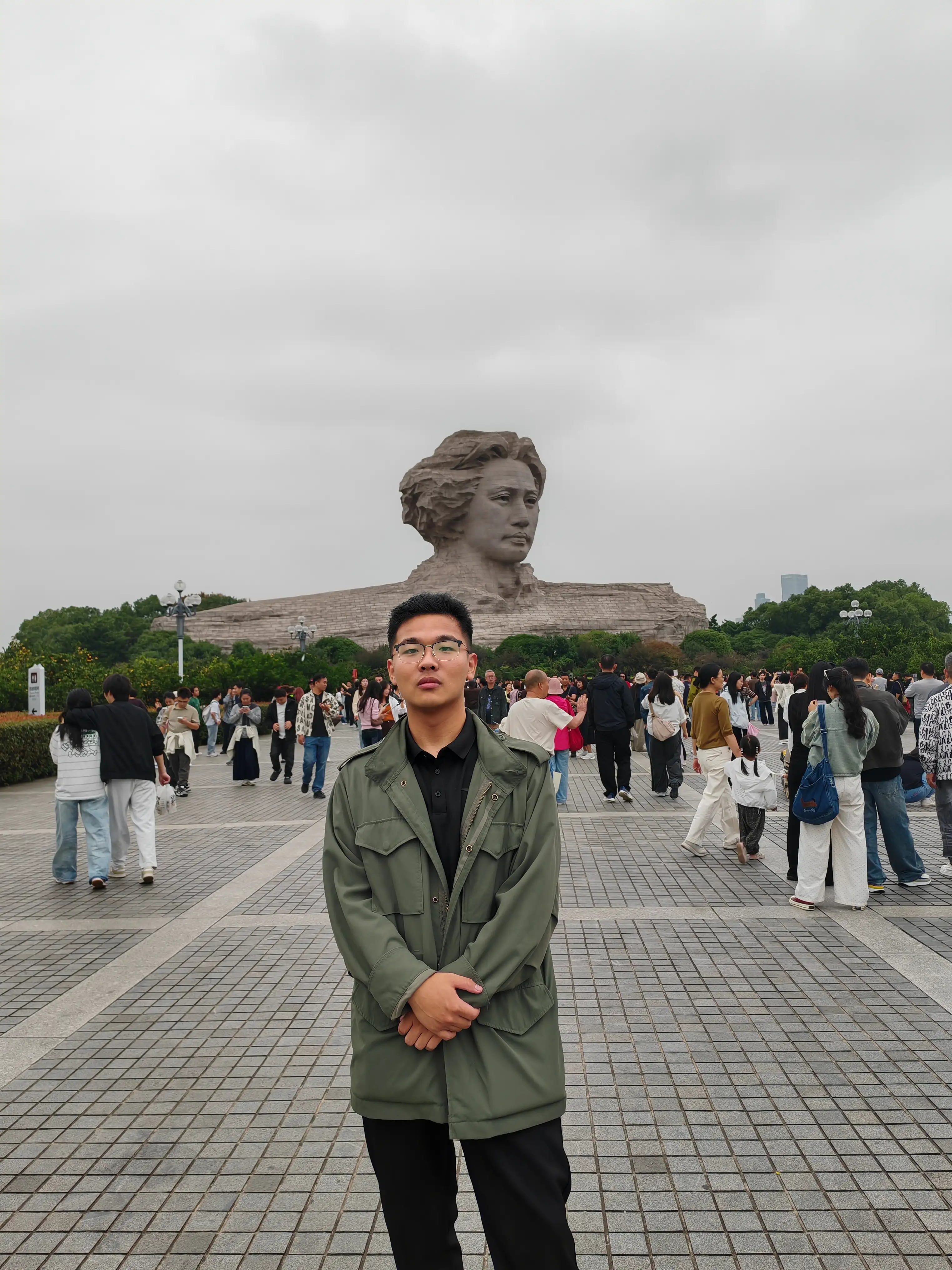
On October 19 I went to Changsha for Honor's final interview, and on the way back stopped by Orange Isle; those two photos were taken that day. The other three are from going out with classmates during National Day. All casual shots, a record of who I am now.
 1 / 5